A story by Jacopo Civai
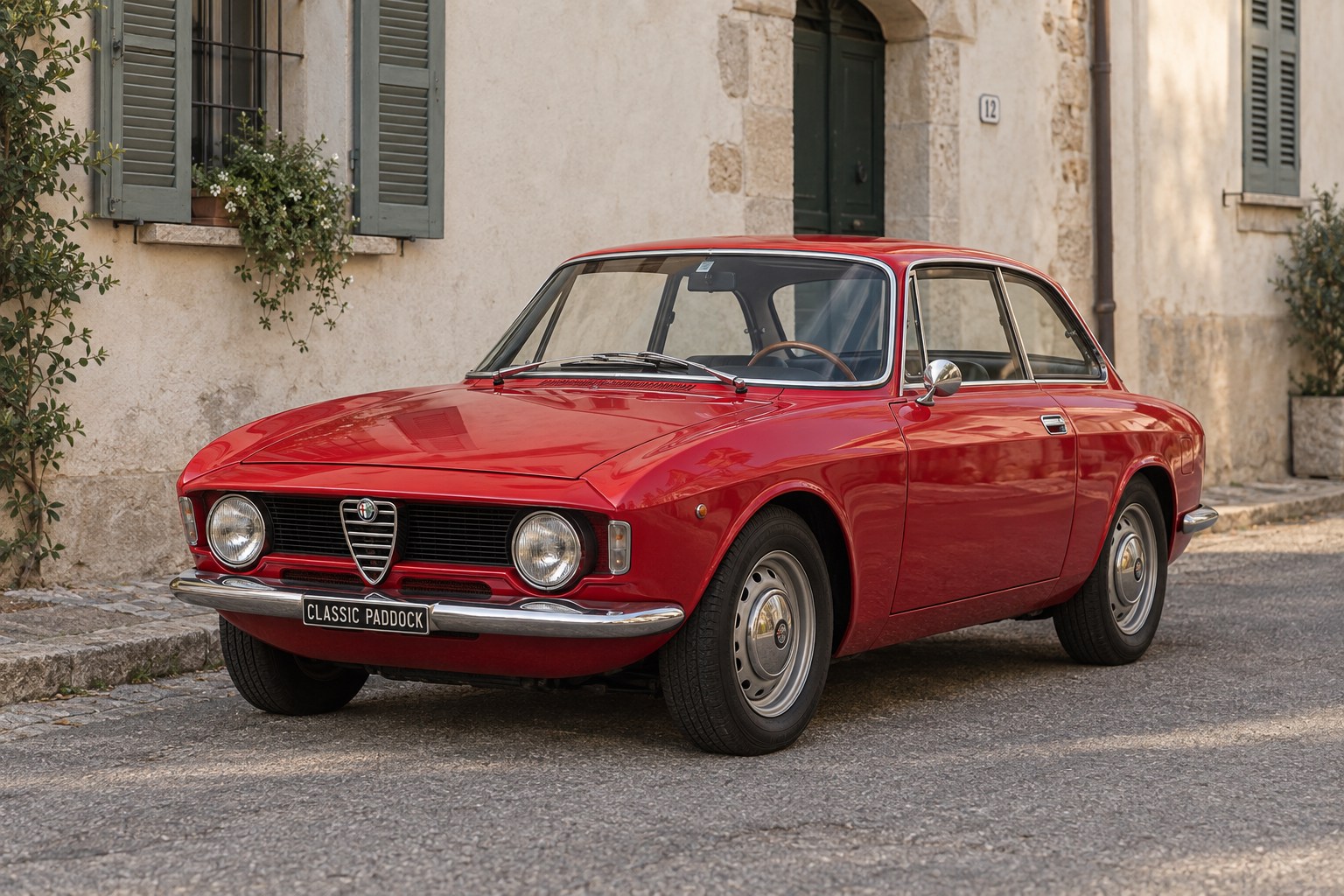
AI-generated editorial illustration inspired by a photograph of the car.
It had to be a Scalino, a 1300, in Rosso Alfa 501.
The search
I created Vintage Paddock partly for a very personal reason: the search for my Alfa Romeo GT Junior Scalino in Rosso Alfa 501.
It was a car I had always had in mind. Not simply because it is a beautiful Alfa, but because, to me, it represents a particular way of enjoying historic cars: clean lines, honest engineering, compact dimensions and character. Elegant, but not delicate. Sporting, without having to show off.
It had to be a Scalino, a 1300, in Rosso Alfa 501.
I searched for two years. Two years of reading adverts to the last line, making phone calls, receiving photographs, having doubts, abandoning trips and considering cars that seemed interesting at first but never quite convinced me. Sometimes the history did not add up, sometimes it was the restoration, the price, or simply a feeling that this was not the one.
And so I kept looking.
For me, it was a significant sacrifice. You do not buy a car like this lightly. I had to wait, make choices, give up other things and hold on to the idea I had in mind, even when settling would have been easier. But when you really want a particular car, the wrong compromise stays with you.
The advert in La Manovella
Then I found it in La Manovella, the ASI magazine.
The advert was simple, as serious things often are. A gentleman was selling his 1969 Alfa Romeo GT Junior in Rosso Alfa 501, with Targa Oro certification, which he had owned from new for more than fifty-five years.
I went to see it.
Almost immediately, I understood why I had waited so long. The colour was exactly what I had been looking for. In person, the stepped nose had a presence that photographs can never quite convey. The interior had been carefully preserved, without the artificially new feeling you sometimes find in cars restored purely for show. Its history was clear and easy to follow, and you could see that it had been looked after.
It was not just beautiful. It was convincing.
I bought it. From that moment, the search, with all its waiting and sacrifices, became part of my own story with the car.
The Scalino detail
“Scalino” is the small step between the bonnet and the nose of the early Giulia GT. It seems a minor detail, but for those who love these cars it is one of the things that make a difference.
It gives the nose a more distinct identity, purer and closer to the earliest cars. It is not a showy feature, but it changes the way you look at the car. It is one of those details you might notice a moment later, then find yourself looking for every time.
For me, the Scalino has always been the GT Junior’s finest face.
The nickname comes from one of the most cherished details in the entire Giulia GT family. That small step was part of the model’s early styling and production approach, but over time it became one of the most recognisable and sought-after features of the first series. The stepnose versions represent the purest, earliest expression of Bertone’s shape, before the later styling updates.
Junior only in name
The GT 1300 Junior was conceived as the more accessible version of the Giulia GT family, yet behind the wheel it never feels like a compromise.
It has everything an Alfa of that period should have: the twin-cam engine, five-speed gearbox, rear-wheel drive, disc brakes and an overall balance that is rarely found today.
The 1300 is not about headline figures. It wants to be driven. You have to keep it in the right rev range, listen to it and work with the gearbox. That is where you understand its character: not in outright power, but in the way it draws you into the driving.
The GT Junior arrived in 1966, using the shape designed by a young Giorgetto Giugiaro for Bertone. A long bonnet, a cabin set well back, slim pillars, a short tail and clean surfaces. Nothing forced. No unnecessary detail. Just balance.
The Junior is an honest car. It asks for your attention and rewards you with feeling.
Rosso Alfa 501
Colour was essential to me.
I wanted it in Rosso Alfa 501 because that is how I had always imagined it. On this shape, red is not just a cosmetic detail: it completes the car. It brings out the nose, the flanks and the lines of the bonnet, and gives the Junior the presence I was looking for.
Not every car needs to be a particular colour. For me, this one did.
On a GT Junior, Rosso Alfa is more than a colour: it is a cultural statement. It evokes an Italy of winding hillside roads, workshops smelling of petrol and hot oil, and weekends spent driving without a particular destination.
A history that matters
The fact that it had Targa Oro certification and had stayed with the same owner for more than fifty-five years played a very important part in my decision.
A history like that cannot be created afterwards. You cannot add it through restoration or an attractive description. It is either there or it is not.
In this case it was there, and it showed: in the documents, the overall condition, the interior and the way the car had been maintained. That means a great deal to an enthusiast. When you buy a historic car, you are not just buying the model; you are also buying the journey that particular car has taken before reaching you.
The first drive
I was excited the first time I drove it. After two years of searching, I was almost afraid that the idea I had built up in my mind would be stronger than the real car.
Instead, it won me over straight away.
It is small, light and direct. The engine has a voice, the gearbox calls for a deliberate hand and the steering tells you what is happening beneath the wheels. You do not need to drive fast to feel it. You just have to find the right rhythm.
That is exactly what I like: the GT Junior does not try to impress you. It wins you over gradually, through the quality of its controls, the sound of the twin-cam and the feeling of truly being part of the driving.
Why Vintage Paddock began
While searching for this car, I realised how poorly historic cars are often presented.
Adverts with too few photographs, vague descriptions, important details left out and prices without context. Yet behind many cars there are wonderful stories, attentive owners, years of care, documents and details that deserve space.
Vintage Paddock also grew from this idea: to give classic cars a place where they are presented with more respect, more precision and more passion.
My 1969 GT Junior Scalino in Rosso Alfa 501, with Targa Oro certification, found in La Manovella after two years, was one of the reasons to begin. It had always been my dream. Bringing it home took time, sacrifice and patience. But every time I look at it, every time I see that stepped nose and the Rosso Alfa 501 I searched so long for, I know exactly why it was worth it.